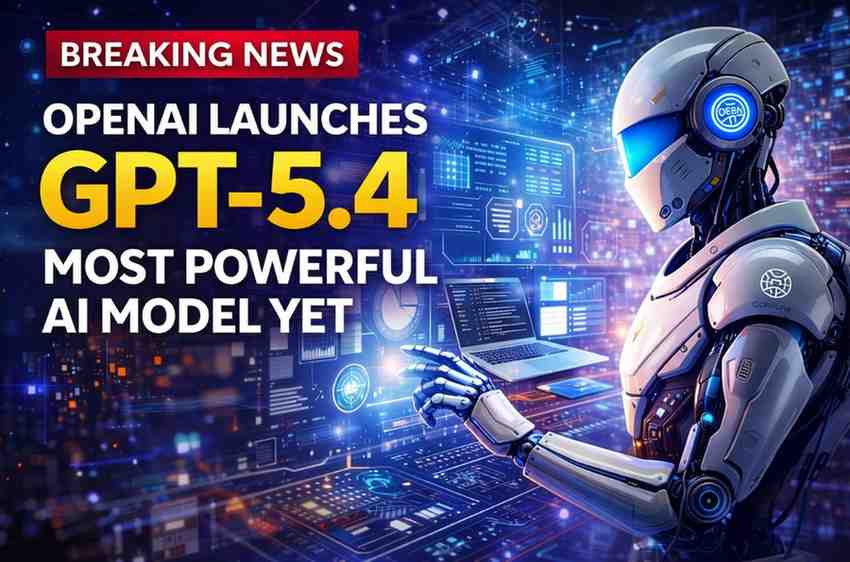
OpenAI has officially introduced GPT-5.4, its most advanced artificial intelligence model to date, marking a major step forward in AI performance for professionals, developers, and businesses. The new model is now available in ChatGPT, the API, and Codex, bringing significant improvements in reasoning, coding capabilities, tool usage, and real-world productivity tasks.
GPT-5.4 builds on the foundation of previous models but integrates several major advancements into a single system designed to handle complex professional work more efficiently. The company also introduced GPT-5.4 Pro, a higher-performance version aimed at users who require maximum accuracy and power for demanding workflows.
Stronger Performance Across Real-World Work
One of the biggest upgrades in GPT-5.4 is its ability to complete professional tasks across industries. According to OpenAI’s evaluation benchmarks, the model matches or outperforms industry professionals in 83% of knowledge-work comparisons, a significant improvement over previous versions.
The model has been specifically optimized for common workplace tasks such as:
Creating spreadsheets and financial models
Writing detailed documents and reports
Designing presentations and slides
Analyzing data and workflows
In internal testing, GPT-5.4 achieved 87.3% accuracy in spreadsheet modeling tasks, a major improvement over GPT-5.2.
Major Improvements in Coding and Development
GPT-5.4 also integrates the advanced coding abilities of GPT-5.3-Codex, making it a powerful tool for developers.
On the SWE-Bench Pro benchmark, which measures software engineering performance, GPT-5.4 slightly outperformed earlier models while operating with lower latency.
Developers can now use GPT-5.4 to:
Write and debug complex software code
Build applications faster
Test and improve software automatically
Automate development workflows
OpenAI also introduced experimental tools allowing the model to test applications during development using browser automation tools like Playwright.
First General-Purpose Model With Native Computer Use
A major innovation in GPT-5.4 is native computer-use capability. The model can interact with software interfaces, websites, and applications by analyzing screenshots and issuing keyboard or mouse commands.
This means AI agents built on GPT-5.4 can perform real tasks such as:
In the OSWorld benchmark, which measures computer-use ability, GPT-5.4 achieved 75% success, surpassing previous AI models and even exceeding human performance levels in some scenarios.
Smarter Tool Usage and Web Research
GPT-5.4 also introduces improved tool search and agentic workflows, allowing AI systems to choose the right tools automatically when completing complex tasks.
The model is better at:
On the BrowseComp benchmark, GPT-5.4 improved performance by 17% compared to GPT-5.2, showing major gains in deep web research tasks.
Larger Context Window for Long Tasks
GPT-5.4 supports up to 1 million tokens of context, enabling it to analyze extremely long documents, datasets, or codebases without losing track of information.
This capability allows the model to work across extended workflows such as:
Faster and More Efficient AI
Despite its improved capabilities, GPT-5.4 is also more efficient than previous models. OpenAI says the model uses fewer tokens to solve problems, reducing costs and improving speed for developers and businesses.
The company has also introduced features like tool search, which can reduce token usage by up to 47% in tool-heavy workflows.
Availability
GPT-5.4 is currently rolling out across:
The GPT-5.4 Pro version is available for enterprise users and developers requiring maximum performance.
OpenAI says the model represents a major step toward more reliable AI agents capable of completing real-world tasks across software, websites, and professional environments.